9 estates compared2026 prices & hoursAntinori vs Castello di AmaHow to actually get inUpdated 14 min read
The Most Beautiful Winery in Tuscany? Start With Antinori
Built almost invisibly into a Chianti hillside, Antinori nel Chianti Classico has a vineyard growing on its roof, a spiral staircase, underground cellars and wide views over the Tuscan hills. It is our pick for the most spectacular winery in Tuscany, although Castello di Ama may be the more beautiful visit if you picture stone villages, not modern architecture.
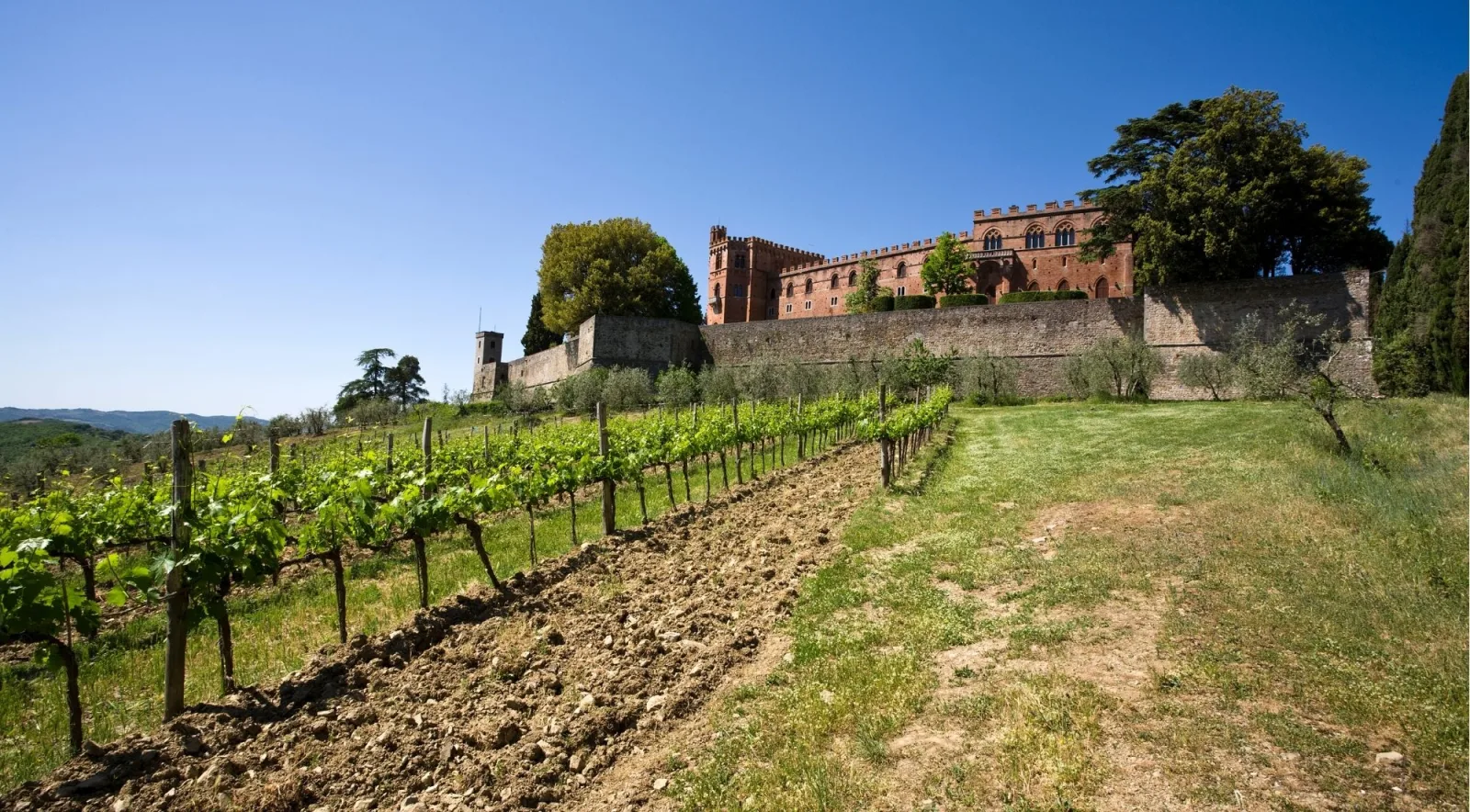
Castello di Brolio, held by the Ricasoli family since 1141, the place to go if "beautiful" means a castle above the vines.
If we had to choose one, Antinori nel Chianti Classico is the most visually spectacular winery in Tuscany, but Castello di Ama is arguably the more beautiful Tuscan experience.
Antinori is the pick if "beautiful" means extraordinary architecture, vineyards, panoramic views and a genuine wow moment. Its contemporary winery is built into a hillside south of Florence, with vines growing across the roof and a sweeping Corten-steel spiral staircase cutting through the building.
Castello di Ama is the better choice if your idea of beautiful is old stone, quiet vineyards, contemporary art and a historic hamlet: something more intimate.
Antinori nel Chianti Classico, at Bargino near San Casciano in Val di Pesa, is the best answer for most visitors. No other Tuscan estate combines architectural significance, integration with the landscape, art, interiors and a well-run visit as completely. It was voted number one in the World's Best Vineyards awards in 2022, and it is one of only three Tuscan wineries that Architectural Digest picked for its worldwide selection of beautifully designed wineries. The other two are also on this page.
But if by "beautiful" you mean the Tuscany you have been dreaming about, go to Castello di Ama instead. Choose Antinori if architecture and the wow moment matter most to you, and Ama if you would rather spend the afternoon among old stone, vines and art. Three more estates win a category of their own:
One practical warning before you plan anything around it: no scheduled group tour visits Antinori. The estate sells its visits directly, and you need a car or a taxi to reach it. If nobody in your party wants to be the designated driver, the answer is a guided Chianti Classico day instead — same hills, different estates, someone else at the wheel.
Start here
Which kind of beauty do you actually mean?
The reason this question produces arguments is that the contenders are not the same kind of object. Antinori, Petra and Rocca di Frassinello are works of contemporary architecture. Castello di Ama is a hilltop hamlet full of contemporary art. Brolio and Banfi are castles with a wine business attached. Il Borro is an entire restored medieval village. Badia a Coltibuono is a former monastery. Calling them all "wineries" hides most of what makes each one beautiful.
So rather than ranking them against each other, match the estate to the picture already in your head. Find your row, and skip to that section.
If you picture…
Go to
Where
Why it wins
Visit from
Everything at onceThe safe answer
Antinori nel Chianti Classico
Bargino, San Casciano in Val di Pesa
Buried in the hill under a working rooftop vineyard; Corten spiral stair; museum, art project and rooftop restaurant
€50
Old stone, vines and artThe romantic
Castello di Ama
Ama, Gaiole in Chianti
A hilltop hamlet among the vines, with site-specific works by artists including Louise Bourgeois, Anish Kapoor and Daniel Buren
€90, 1.5 hrs
A castle winery in Brunello countryThe castle
Castello Banfi
Poggio alle Mura, Montalcino
A medieval castle among Brunello vineyards, with an enoteca, restaurants, a hotel and a glass museum
€60 tour & tasting
A castle above the vinesThe postcard
Castello di Brolio
Gaiole in Chianti
Ricasoli family since 1141; battlements, formal gardens, cypresses and the widest views in Chianti
Book direct
A honeymoon photographThe fairytale
Il Borro
Valdarno, between Florence and Arezzo
A restored medieval borgo inside a working organic estate — artisan workshops, restaurants and rooms
Tastings and stays, book direct
Worn stone and cloistersThe historian
Badia a Coltibuono
Gaiole in Chianti
Monastery founded in 1051 — cloister, frescoed salons, Italian garden, thousand-year-old cellars
€35, 1.5 hrs
One powerful buildingThe architect
Petra
Suvereto, Val di Cornia
Mario Botta's monumental stone cylinder cut into the hillside — a "cathedral of wine"
Book direct
A theatrical cellarThe dark room
Rocca di Frassinello
Gavorrano, Maremma
Renzo Piano's 40 × 40 m sunken barrel room beneath a terracotta terrace, holding around 2,000 barrels
$40
Vines running to the seaThe coast
Tenuta Ammiraglia
Magliano in Toscana, Maremma
Frescobaldi's low, ship-like winery by Sartogo and Grenon, aimed at the Tyrrhenian
Book direct
Euro prices are the estates' own published 2026 rates; the two coastal wineries quote by experience, so check when you book. Everything on this list is appointment-only — see our region-by-region guide to Tuscan wineries for the wider field.
If you'd rather not drive
Guided ways into these landscapes
Here is the part the "most beautiful winery" articles never mention: the two prettiest estates in Chianti are an hour apart on winding roads, both pour generously, and Italy's drink-drive limit is 0.5 g/L, roughly one glass. A guided day solves that, and solves the other problem too, which is that famous names are frequently fully booked for individuals. These tours don't enter Antinori — nothing scheduled does — but they take you into the same Chianti Classico hills around San Casciano, Greve and Castellina, and someone else drives.
Two working family estates in the same stretch of hills as Antinori and Castello di Verrazzano, with guided cellar walks and tastings paired with pecorino and estate oil. The cheapest reliable way inside a real Chianti Classico cellar without a car, and the most-reviewed tour on this site by a wide margin.
$96 · 4.6★ (800+ reviews) · 5 hours · minivan from Siena
The closest thing to the Brolio experience on a scheduled tour: two renowned Chianti estates plus the walled castle town of Castellina in Chianti, by minivan rather than coach. Siena pickup makes it the natural choice if you're based south of the Chianti hills, not in Florence.
$40 · 4.6★ (20 reviews) · about 1.5 hours · Gavorrano, Maremma · sold by the winery itself
The one estate on this page you can book like a normal ticket. Renzo Piano's terrace, the sunken barrel room, the Etruscan collection curated by Italo Rota, then four wines with schiaccia. You drive yourself — it's deep in the Maremma — but there are no phone calls and no waiting list.
Driving anyway? Book the estates directly, two to four weeks ahead between May and October, and nominate your driver before the first pour rather than after it.
Antinori is one of those rare wineries that can be worth visiting even if you are only casually interested in wine. It works as a winery, an architecture destination, a design experience, a restaurant stop and a lesson in one family's wine history, all at once.
Most famous wineries grew over centuries. Antinori had the unusual chance to build a contemporary winery for a family with centuries of wine history, and the visitor route reflects that: vineyard-covered architecture, production areas, barrel cellars, art, the spiral staircase, tasting rooms, a wine museum, the views and a restaurant.
The achievement at Antinori nel Chianti Classico is that a very large industrial winery does not read as a large industrial building. Archea Associati, led by Marco Casamonti, treated the landscape itself as the architecture: most of the winery disappears into the hillside, and its planted roof becomes, in effect, another vineyard. From the road the building announces itself only through two long horizontal slots that follow the slope of the land.
That matters more in Tuscany than anywhere else, because the competition here isn't other buildings, it's the view. Antinori is unusually successful on the one criterion that decides the question locally: it intensifies the landscape rather than competing with it. The architects describe the project as an attempt to merge the building into the countryside, with vines and soil over the roof and the openings set along the contours. Terracotta and other local materials carry the reference inside, and burying the structure does the temperature control for free.
Then you arrive, and it changes character completely. The restrained horizontal exterior is punctured by an enormous Corten-steel spiral staircase — the most photographed element of the place, and the one Architectural Digest singled out along with the vine-planted roof when it selected Antinori for its worldwide list.
Inside it gets darker and more theatrical. The barrel-ageing hall is buried in the hill beneath repeated terracotta vaults; the architects call it the secluded heart of the winery, where the darkness and the rhythm of the vaults produce something close to a sacred quality while delivering exactly the conditions the wine needs. The whole building is organised vertically so that wine descends through production by gravity, while visitors climb through production, exhibition and tasting spaces toward the public rooms at the top. The architecture is not purely decorative: it is part of how the wine is made.
And it is more than a cellar. There are museum and exhibition areas, an auditorium, tasting rooms, and the Antinori Art Project, founded when the winery opened in 2012 to commission contemporary art alongside the family's older collection. The rooftop restaurant, Rinuccio 1180, supplies the final move: wide windows looking back out over olive groves, hills and country churches, returning you to the countryside the building had just vanished into.
Visiting Antinori — checked October 2026
Where: Via Cassia per Siena 133, Bargino, San Casciano in Val di Pesa — about 30 minutes south of Florence on the Firenze–Siena superstrada.
Hours: April–October, daily 10:00–18:30. November–March, Monday–Friday 10:00–17:30 and weekends 10:00–18:00. Last entry roughly an hour before closing.
Tinaia tour — €50 per adult, about 90 minutes. Spiral stair, rooftop vineyard, production areas and museum, closing with three wines tasted in the glass-walled room overlooking the family's art collection. Under-17s €10; under-6s free.
Bottaia tour — €75 per adult, about 2.5 hours. More time in production and the barrel cellars, with four wines including Badia a Passignano Gran Selezione. No food. Ages 7–17 €15.
CRU experience — €190 per person, about 2.5 hours plus lunch. Four wines including Tignanello and Pian delle Vigne Brunello, tasted in the bottaia or the suspended glass room above the barrel cellar, then lunch at Rinuccio 1180.
Rinuccio 1180: lunch 12:00–16:00 on winery opening days.
Booking: strongly advised. Antinori states plainly that entry without a reservation may be limited during busy periods or private events, and is not guaranteed. Payment is by card and non-refundable.
Independent recognition is unusually strong for a working winery: Architectural Digest lists it among the world's best vineyard designs, Tuscany's own tourism board calls it one of the region's most beautiful architect-designed wineries, and it won the 2022 World's Best Vineyards poll outright — the first Italian estate to top that list, after placing 18th, 9th and 6th in the preceding years.
Taken together, that gives Antinori something none of its rivals quite matches. Brolio has more historical romance. Petra is arguably the purer architectural object. Il Borro is more dreamily picturesque. But Antinori is excellent at every form of beauty simultaneously, which is precisely why it wins a question this loosely worded.
Is it too modern to feel like Tuscany?
Possibly, depending on what you expect. If your picture of a Tuscan winery is a tiny stone farmhouse, a cypress lane and a family cellar, Antinori may feel too polished. That is why it is not necessarily Tuscany's most charming winery. For pure visual impact, though, it is very hard to beat.
What is the Antinori tour like?
Antinori sells three standard visits. The Tinaia tour is good for architecture and first-time visitors. The Bottaia tour goes into more detail on production and the cellars. The CRU tour adds premium wines and a meal. If wine matters to you as much as the architecture, choose one of the deeper visits over the basic one; prices and times are in the box above.
Don't skip lunch
Rinuccio 1180, the restaurant on the roof terrace, gives Antinori a major advantage as a winery to build a whole day around. With lunch the visit becomes architecture, wine, a long Tuscan lunch and the countryside, not simply a tasting appointment.
Keep exploring Tuscany
Other experiences you might enjoy
Beautiful wineries rarely sit alone. Antinori and Badia a Coltibuono are both within an hour of Florence and Greve in Chianti; Castello di Brolio is a short drive from Siena; Rocca di Frassinello and Petra pair naturally with Grosseto, Bolgheri and the Maremma coast; and Il Borro sits between Florence and Arezzo. Browse related Chianti, Siena, San Gimignano and Tuscan coast experiences below.
The best alternative
Castello di Ama — the most romantic Tuscan experience
If your question is "Which winery will make me feel like I am actually in Tuscany?", we might choose Castello di Ama.
Ama sits near Gaiole in Chianti, about 500 metres up, in a historic hilltop hamlet surrounded by vineyards and roughly half an hour's drive from Siena. A visit combines:
old stone buildings;
cellar spaces;
serious Chianti Classico;
contemporary art;
the vineyard landscape.
The art collection has grown since 1999 to works by 19 artists, among them Louise Bourgeois, Anish Kapoor, Daniel Buren, Michelangelo Pistoletto, Hiroshi Sugimoto and Lee Ufan, placed around the hamlet and its cellars.
Visiting Castello di Ama — checked October 2026
Where: Località Ama, Gaiole in Chianti, near Lecchi. About 15 minutes from Gaiole or Radda.
Booking: required for every tour, and each one starts with a walk through the hamlet and its art.
Journey to Ama — €90 per person, about 1.5 hours. Three wines, in a shared group of up to seven. Longer and private tastings run from €129 to €279.
With lunch — €169. A shared tour, then a set lunch with three wines at Il Ristoro di Castello di Ama.
The enoteca: Monday to Saturday, 10:00–19:00.
The art is part of the estate itself, not simply hung on the walls of a tasting room.
Antinori vs Castello di Ama
Out of five
Antinori
Castello di Ama
Wow factor
★★★★★
★★★★
Tuscan romance
★★★★
★★★★★
Modern architecture
★★★★★
★★★
Historic atmosphere
★★★
★★★★★
Contemporary art
★★★★
★★★★★
Vineyard scenery
★★★★
★★★★★
Serious wine
★★★★★
★★★★★
Intimate feeling
★★★
★★★★★
In short: Antinori impresses you. Castello di Ama seduces you. These are our own scores, not an award.
The most beautiful traditional winery
Castello Banfi — the castle winery
If you want a castle, stone buildings, Brunello country, the vineyard landscape, an enoteca and a restaurant all in one place, look at Castello Banfi. This is romantic, traditional-looking Tuscany, with no modern architecture in sight.
The medieval castle of Poggio alle Mura stands among the vineyards south of Montalcino, and the estate around it has grown into a small village of hospitality: the L'Enoteca wine bar, the La Taverna restaurant, the Michelin-starred La Sala dei Grappoli, the Il Borgo hotel and a museum of glass and bottles.
Tours: booking ahead is required. The public tour lasts about an hour and ends with a tasting for €60, or with lunch at La Taverna for €125–140.
The catch: as at Brolio, the working cellar is not inside the castle. It is 4 km away, so you need your own car between the two.
Castello di Brolio — castle, history and sweeping views
If "beautiful" means a castle, history and sweeping views, Brolio belongs on the shortlist. If your mental image is battlements, cypresses, formal gardens and vineyards falling away in every direction, Brolio is an emotionally satisfying answer, and I'd send you there without hesitation.
The Ricasoli family's connection to Brolio is documented from 1141, which makes this landscape inseparable from the history of Chianti itself, Bettino Ricasoli wrote the original Chianti formula here. The estate today runs to some 1,200 hectares, 240 of them under vine. Visitors walk the grounds, the gardens and the Ricasoli collection, and tastings connect the castle above with the cellars below.
Brolio's advantage is silhouette. The fortified castle dominates its vineyards rather than dissolving into them, the exact inverse of Antinori. One says architecture belongs to the hill; the other says architecture commands it. Both are profoundly Tuscan, in different centuries' languages.
The caveat is definitional, and you should know it before you book. The beautiful castle and the working winery are not the same building: Ricasoli's production cellars sit below at Madonna a Brolio. So Brolio is the most beautiful wine estate in Tuscany, while Antinori makes the stronger case for most beautiful winery.
Hours 2026: 20 March – 8 October, daily 10:00–19:00; 9–31 October, daily 10:00–18:30; 1 November – 20 December, daily 10:00–17:00. The ticket office closes an hour earlier, and the castle is closed from January to mid-March.
Tickets: book online through the estate. Garden and museum entry, guided castle tours with a tasting and vineyard tours are sold separately, and the options change by season, so check the current prices when you book.
Getting there: Gaiole in Chianti, about 20 minutes east of Castellina and an hour from Florence. No usable public transport.
From $96·4.6★ (800+ reviews) ·5 hours·Free cancel · 24h
Brolio takes its own bookings, so no group tour delivers it, but this minivan day from Siena is the closest in spirit: two renowned Chianti Classico estates plus the medieval castle town of Castellina in Chianti, in the same stretch of hills, with a driver.
Central Siena pickup, by minivan instead of coach
Two renowned Chianti Classico wineries with guided tastings
More on the villages, the SR222 wine road and which Chianti day suits you in our Chianti wine tours guide.
Il Borro — the fairytale village
Il Borro is the best choice for fairytale Tuscany, and the only entry here whose visual centre isn't a cellar at all. It's a restored medieval borgo — a whole village — set inside a working organic wine estate in the Valdarno, between Florence and Arezzo.
The castle is first recorded in 1254. Ferruccio Ferragamo bought the property in 1993 and restored the settlement building by building; a purpose-built winery followed in 2004, including a tunnel of roughly 3,000 square metres. Today the estate holds the village, the vineyards, restaurants, rooms, artisan workshops and a great deal of countryside.
Cellar visits and tastings are available, but be clear about what you're going for: the attraction is the settlement in its landscape, not the engineering of the cellar. For a honeymoon, an anniversary, or a photographer chasing an idealised Tuscan village, I'd rank Il Borro above almost anything in the region. For the narrower question of architectural beauty in a winery, it sits below Antinori.
Badia a Coltibuono — the atmospheric answer
Badia a Coltibuono is the opposite of an architectural statement. Its appeal is accumulated time.
The site began as a monastery in 1051 and spent centuries combining contemplation, hospitality and agriculture, which is more or less what it still does. The visitor route runs through the former abbey, the cloister, frescoed salons, the historic ageing cellars and a monumental Italian-style garden, and it is the finest answer in Tuscany for anyone who finds worn stone and monastic courtyards more beautiful than dramatic modern buildings.
The tour: about 1.5 hours through the abbey, Renaissance gardens, frescoed rooms, cloister and thousand-year-old cellars.
Price: €35 per person including a tasting of four wines — Chianti Classico, Chianti Classico Riserva, Cultus Riserva and Sangioveto — with homemade schiacciata. Ages 12–17 pay €12; under-12s free.
Booking: advance booking and payment required, and non-refundable.
Where: Gaiole in Chianti — close enough to Brolio to do both in one day.
It's less spectacular from a distance than Brolio and less daring than Antinori. But few wine visits anywhere in Tuscany have this depth of continuity, and the price is remarkably fair for what you get.
Petra — the serious architectural challenger
For architecture enthusiasts, Petra is the strongest challenge to Antinori, and some will prefer it outright.
Designed by the Swiss architect Mario Botta and built in the early 2000s near Suvereto in the Val di Cornia, Petra is organised around monumental geometry: a cylindrical core flanked by rectilinear volumes, with much of the winery continuing underground into the slope. The exterior is clad in warm stone, setting up a deliberately forceful argument between an abstract geometric building and the Mediterranean landscape around it. Architectural Digest picked out the cylinder, the planted roof and the rough-hewn stone when it included Petra in the same worldwide selection as Antinori.
Where Antinori nearly erases itself, Petra wants to be seen. The cylinder rises from the vineyard like land art, or a sanctuary. Inside, verticality, light and stone produce the monumental atmosphere the estate itself calls a "cathedral of wine." If your definition of beauty is one powerful object instead of a coherent journey, choose Petra and don't feel you've settled.
Petra is best for:
design travellers;
Etruscan Coast itineraries;
repeat visitors;
anyone who wants a lesser-known architecture stop.
Petra sits in the same coastal band as the Super Tuscan estates — see our Bolgheri & Super Tuscan guide for how to route a day along the Etruscan coast.
Rocca di Frassinello — the one everyone forgets
Rocca di Frassinello is the candidate missing from almost every shortlist, including the AI-generated ones, and it belongs on all of them.
The Gavorrano winery was designed by the Renzo Piano Building Workshop between 2001 and 2007. At its centre is a subterranean barrel room of roughly 40 by 40 metres, sunk underground for naturally stable temperature and humidity, with around 2,000 barrels resting in near-darkness. Production functions ring the void, and gravity moves grapes and wine through parts of the process.
Above it sits an enormous terracotta-covered terrace — Piano calls it a kind of sagrato, the forecourt of a church — while a tower draws light down toward the buried interior. Visitors arrive on that terrace with the Maremma hills opening out in every direction, then descend into the dark. It is the most theatrical sequence at any winery in Tuscany, and the barrel room may simply be the finest cellar interior on this page.
Designed by Renzo Piano, it is one of Tuscany's strongest contemporary architecture destinations, and it is best for architecture lovers, a coastal or Maremma trip, and repeat visitors to Tuscany.
I place it just below Petra and Antinori aesthetically, because the above-ground complex is intentionally severe and functional. But it has one decisive practical advantage over every other estate here: you can book it like a normal ticket.
Sold by the winery itself instead of by an operator, which is why it's the most direct route onto this list. The tour opens on Piano's terrace above the Maremma hills, descends into the excavated barrel room, takes in the Etruscan exhibition curated by Italo Rota — artefacts from the San Germano necropolis — and finishes with four wines and Tuscan schiaccia.
Guided tour of the cellar designed by Renzo Piano
The terrace and its views over the rolling hills of the Maremma
The excavated barrel room, where around 2,000 barrels rest in darkness
Tasting of Vermentino, Ornello, Le Sughere di Frassinello and Rocca di Frassinello
In the interests of transparency: this is a small, winery-run listing with only 20 reviews so far, far fewer than the Florence day tours elsewhere on this site; read the most recent ones before you book. Judge it on the architecture and the value per hour, not on review count.
Tenuta Ammiraglia and the rest of the field
One more estate deserves naming, and one correction is due.
Tenuta Ammiraglia — the coastal landscape
Frescobaldi's Maremma estate answers a different landscape entirely: not inland Chianti but the country running down to the Tyrrhenian. Vineyards trace geometric patterns across low hills while the winery itself merges into the contours, its long aerodynamic form usually read as the prow of a ship pointed at the sea. The architects are Piero Sartogo and Nathalie Grenon — stated clearly here, because the attribution gets muddled online. It's elegant at the scale of the landscape, but its interiors are less iconic than Antinori's staircase, Petra's cylinder or Rocca's barrel chamber.
A dense field, not a weak one
Antinori isn't winning against nothing. Tuscany runs a formal Wine Architecture network of design wineries, and the region has one of the densest concentrations of architecturally significant modern cellars anywhere in Italy — Archea Associati, Mario Botta, Renzo Piano, Sartogo and Grenon all built here. The regional government has called the results contemporary "temples of wine." Beating that field is the point.
Read this before you quote it
What "voted the world's most beautiful winery" actually measured
You'll see the claim everywhere that World's Best Vineyards ranked Antinori the most beautiful winery in the world. That is too strong, and here is why before you repeat it over dinner.
Antinori genuinely was voted number one globally in 2022, the first Italian estate to top the list. But the organisation is explicit that its voters — several hundred wine and travel specialists — judge the complete vineyard experience: architecture and surroundings, yes, but also tours, tastings, food, hospitality, service, value and accessibility. It is a wine-tourism award, not a beauty contest.
So the result is powerful evidence that Antinori works exceptionally well as a destination. It is not, on its own, an objective ruling on which building is prettiest.
There's a related confusion to clear up: Antinori's absence from recent rankings is not a demotion. Former number-one estates move into the awards' Hall of Fame and are no longer eligible to be voted back onto the annual list.
The defensible formulation — the one I'd stand behind — is this: Antinori nel Chianti Classico is both an internationally recognised piece of winery architecture and a former world number-one wine-tourism destination, which together make it the best-supported candidate for Tuscany's most beautiful winery.
Pairing two wineries into one trip
Nobody visits one winery and drives home. The second choice is where the day is made or wasted, and the right pairing depends on the contrast you want.
Pairing
The contrast
Distance apart
Verdict
Antinori + Castello di Brolio
A winery that vanishes into the hill, then a castle that commands one
About 1 hour, both in Chianti Classico
The strongest single day in Tuscany for this question
Antinori + Badia a Coltibuono
2012 architecture against a monastery founded in 1051
About 1 hour 15
Best for anyone who wants the historical range
Brolio + Badia a Coltibuono
Castle and abbey, both above Gaiole
15 minutes
The easiest logistics on this page; ideal if you're based in Chianti
Petra + Rocca di Frassinello
Botta's cylinder against Piano's sunken cathedral
About 1 hour, both Maremma / Val di Cornia
The architecture pilgrimage, but give it its own day
Antinori + anything coastal
Chianti hills to the Tyrrhenian
2–3 hours' drive
Don't. Split them across two days or you'll spend the day in the car
The best pairing of all: Antinori and a small winery
This makes a stronger day than choosing between "famous" and "authentic". Do both:
Morning: Antinori, for the architecture, the scale and the history.
Afternoon: a small family winery, for intimacy, a traditional cellar and conversation with the people who make the wine.
If you're building the trip instead of the day, our where to stay in wine country guide covers basing yourself in Chianti versus Florence, which changes these drive times considerably.
Best views, couples and photographers
Which winery has the best views?
The strongest candidates are Castello di Ama, Castello di Brolio, Castello Banfi, Antinori and Rocca di Frassinello.
Best for couples
Castello di Ama. It feels quieter and more intimate than Antinori.
Best for photographers
If you want to photograph
Go to
Architecture
Antinori
Old Tuscany
Castello di Ama
Castles
Brolio or Banfi
Modern architecture
Rocca di Frassinello or Petra
Is Antinori worth visiting if you don't drink wine?
Yes. It works as an architecture, design and food destination, and that broad appeal is one of the reasons it ranks first.
Can you just turn up?
We would not rely on it. For any winery visit that matters to you, reserve ahead.
How long should you allow?
A quick stop: 1–1.5 hours.
A proper visit: 2–3 hours.
The best experience: 3–4 hours or more, including lunch.
Practical notes before you book any of them
All appointment-only
Every estate on this page requires a reservation. Book two to four weeks ahead between May and October; longer if you want a specific time or a lunch slot.
Payment is usually non-refundable
Antinori and Badia a Coltibuono both take card payment up front and don't refund. Book the date you're sure about.
Someone has to drive
Italy's limit is 0.5 g/L, about one glass. Two estates in a day means a designated driver, a taxi, or a private driver-guide.
Cellars are cold
The buried rooms at Antinori and Rocca di Frassinello sit well below outside temperature even in August. Bring a layer, and wear closed shoes — see our what to wear guide.
Budget the tasting fees
€35–€50 per person is normal at this level, €190 at the top. That's separate from lunch, and separate from anything you buy.
Photography rules vary
Most of these estates welcome photographs, but drones and tripods generally aren't allowed, and some interiors and art rooms are restricted. Ask at reception.
The most beautiful winery in Tuscany, by type
Best for
Winery
Most spectacular overall
Antinori
Most romantic
Castello di Ama
Best castle
Castello Banfi
Best for art
Castello di Ama
Best architecture
Antinori
Best balance of beauty and serious wine
Castello di Ama
Best hidden architecture choice
Petra
Final verdict
Antinori nel Chianti Classico is the best answer for most visitors. But if by "beautiful" you mean the Tuscany you have been dreaming about rather than cutting-edge architecture, visit Castello di Ama.
Frequently asked — the most beautiful winery in Tuscany
What is the most beautiful winery in Tuscany?
Antinori nel Chianti Classico at Bargino, near San Casciano in Val di Pesa, is the best-supported single answer. Designed by Archea Associati and opened in 2012, it is buried in a hillside beneath a working rooftop vineyard, entered by a Corten-steel spiral staircase, and was voted number one in the World's Best Vineyards awards in 2022. If your idea of beauty is old stone, quiet vineyards and art more than contemporary architecture, Castello di Ama near Gaiole in Chianti is the more romantic choice.
How much does it cost to visit Antinori nel Chianti Classico?
The entry-level Tinaia tour costs €50 per adult and lasts about 90 minutes, covering the spiral staircase, rooftop vineyard, production areas and museum, with a tasting of three Antinori wines. Youths up to 17 pay €10 and children 6 and under are free. The CRU experience, at €190 per person, runs about two and a half hours and finishes with lunch at the rooftop restaurant Rinuccio 1180.
Is Antinori or Castello di Ama more beautiful?
Antinori is the more spectacular: a winery buried in a hillside under a rooftop vineyard, with a Corten-steel spiral staircase and wide views. Castello di Ama is the more romantic: a historic hilltop hamlet among the vines near Gaiole in Chianti, with contemporary art by artists such as Louise Bourgeois and Anish Kapoor. Antinori impresses you; Castello di Ama seduces you.
Is Antinori worth visiting if you don't drink wine?
Yes. It works as an architecture, design and food destination as well as a winery, with the rooftop restaurant Rinuccio 1180, and that broad appeal is one of the reasons it ranks first.
How long should you allow for a winery visit in Tuscany?
Allow 1 to 1.5 hours for a quick stop, 2 to 3 hours for a proper visit, and 3 to 4 hours or more for the best experience, including lunch. Reserve ahead; don't count on turning up.
Do you need to book Antinori nel Chianti Classico in advance?
Yes. Antinori states that entry without a reservation can be limited during high turnout or private events, and that admission is not guaranteed without a booking. Tours are also capped and sell out in the April to October season, so reserve directly on the estate's website before you travel.
What are the opening hours at Antinori nel Chianti Classico?
From April to October the winery opens daily 10:00 to 18:30. From November to March it opens Monday to Friday 10:00 to 17:30 and at weekends 10:00 to 18:00. The rooftop restaurant Rinuccio 1180 serves lunch from 12:00 to 16:00 on winery opening days. Last admission is roughly one hour before closing.
Was Antinori really voted the most beautiful winery in the world?
Not exactly. Antinori nel Chianti Classico was voted number one in the World's Best Vineyards awards in 2022, but that poll judges the complete visitor experience — architecture and setting alongside tours, tastings, food, hospitality, service and value. It is strong evidence that the place works superbly as a destination, not a formal beauty prize. Antinori has since entered the awards' Hall of Fame, which is why it no longer appears in the annual list.
Can you visit Antinori nel Chianti Classico on a day tour from Florence?
Not on a standard group tour. Antinori sells its visits directly and no scheduled Chianti day tour includes it, so you book the estate yourself and drive or take a taxi the 30 minutes south from Florence. Guided Chianti Classico day tours visit other family estates in the same hills, which is the practical option if nobody in your group wants to stay sober.
Which is the most beautiful castle winery in Tuscany?
Castello Banfi, south of Montalcino, if you want the castle, the Brunello vineyards, an enoteca and a restaurant in one place. Castello di Brolio at Gaiole in Chianti, Ricasoli-owned since 1141, has more history and the widest views over the Chianti hills, and in 2026 is open daily 10:00 to 19:00 from 20 March to 8 October. At both, the working cellars sit apart from the castle: 4 km away at Banfi, and below the castle at Madonna a Brolio.
Which two Tuscan wineries should I combine in one trip?
Antinori plus Castello di Brolio is the strongest contrast — a nearly invisible modern winery and a castle that commands its hill, both in Chianti Classico and about an hour apart. Antinori plus Badia a Coltibuono swaps the castle for an abbey founded in 1051. Antinori plus Petra or Rocca di Frassinello makes the best architecture trip, but those are on the Maremma coast, two to three hours away, so give them a separate day.
Keep planning
Best wineries in Tuscany Region by region
Beyond the beautiful ones. Every region's estates that are actually open, with real tasting fees. Read the wineries guide →
Chianti wine tours Where four of these sit
Antinori, Brolio, Coltibuono and Ama are all in Chianti Classico. Here's how to spend a day among them. Read the Chianti guide →
Private Tuscany wine tours For appointment-only estates
The format that actually gets you into the estates that don't take groups, and drives you between them. Read the private tours guide →
A top-rated small-group tasting in Chianti Classico, and an inexpensive way onto the Bolgheri coast where Petra and Ammiraglia sit — both with free cancellation up to 24 hours before.
Highest rated small group of our picks
From Florence: Small Group Wine Tasting Tour to Tuscany
From $100·4.9★ (4,600+ reviews) ·4.5 hours·Free cancel · 24h
Two renowned Chianti Classico estates, six wines and olive oils with cheese and salami, capped at a small group — the closest a scheduled tour gets to the unhurried pace of arranging estate visits yourself.
From $29·4.7★ (200+ reviews) ·1.5 hours·Free cancel · 24h
The cheapest way onto the coast that Petra, Ammiraglia and the Super Tuscans share — a family-run winery near Bolgheri village, a guided walk through the process, and a tasting of the estate's own Bordeaux-blend reds.
All tours and live availability via GetYourGuide. Listed prices are starting prices in USD; final price varies by date and group size. Estate prices quoted in euros are the wineries' own published 2026 rates.
Pick your tour
Beautiful is easier with a driver
Antinori, Brolio and Coltibuono all take their own bookings and all expect you to arrive by car. If that's not your trip, a guided Chianti Classico day puts you in the same hills, in front of real winemakers, with nobody counting glasses. Book in under two minutes.
Free cancellation up to 24 hours before every tour
Mobile voucher, instant confirmation, no printing needed
Working family estates in Chianti Classico, not commercial tasting rooms